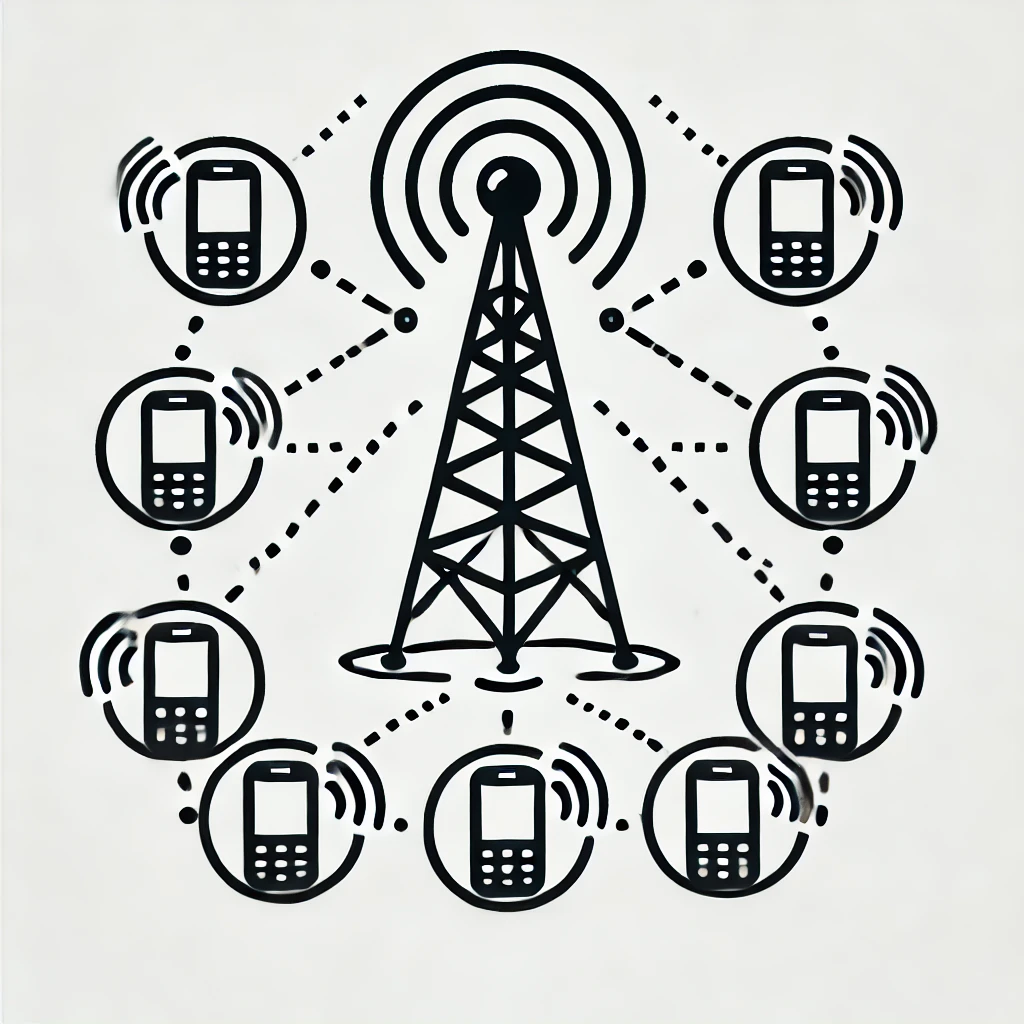
mobile-env is an open, minimalist environment for training and evaluating coordination algorithms in wireless mobile networks. The environment allows modeling users moving around an area and can connect to one or multiple base stations. Using the Gymnasium (previously Gym) interface, the environment can be used with any reinforcement learning framework (e.g., stable-baselines or Ray RLlib) or any custom (even non-RL) coordination approach. The environment is highly configurable and can be easily extended (e.g., regarding users, movement patterns, channel models, etc.).
mobile-env supports multi-agent and centralized reinforcement learning policies. It provides various choices for rewards and observations. mobile-env is also easily extendable, so that anyone may add another channel models (e.g. path loss), movement patterns, utility functions, etc.
As an example, mobile-env can be used to study multi-cell selection in coordinated multipoint. Here, it must be decided what connections should be established among user equipments (UEs) and base stations (BSs) in order to maximize Quality of Experience (QoE) globally. To maximize the QoE of single UEs, the UE intends to connect to as many BSs as possible, which yields higher (macro) data rates. However, BSs multiplex resources among connected UEs (e.g. schedule physical resource blocks) and, therefore, UEs compete for limited resources (conflicting goals). To maximize QoE globally, the policy must recognize that (1) the data rate of any connection is governed by the channel (e.g. SNR) between UE and BS and (2) QoE of single UEs not necessarily grows linearly with increasing data rate.